

On this page
Official Ads MCP vs Third Party: What Actually Differs
Key Takeaway: The official ads MCP vs third party question has no single answer, because the official servers are wildly inconsistent with each other. Amazon's and Meta's let an AI create and change campaigns. Google's and Microsoft's only let it read. The real decision is not official versus third-party — it is how many platforms you run.
Every major ad platform shipped a first-party MCP server between February and June 2026. That is a genuinely good thing, and it makes the obvious question fair: if Amazon, Google, Meta and Microsoft all publish their own servers for free, why would anyone pay for a third-party one?
The honest answer starts with an uncomfortable fact about the official servers themselves. They are not a coherent set. They were built by different teams, on different timelines, with different appetites for risk — and the capability gap between them is enormous.
This post lays out exactly what each one does, then the four things none of them do. If you run one platform and want reporting, the official server is very likely the right call and you can stop reading after the table.
What Will Each Official Server Actually Let AI Touch?
Here is the state of play as of August 2026. This is the table most comparison articles get wrong, because a lot of content published earlier in the year still repeats the claim that official servers are uniformly read-only.

Official server | Shipped | Read | Write | What that means in practice |
|---|---|---|---|---|
Amazon Ads | Open beta, 2 Feb 2026 | Yes | Yes | 50+ tools. Campaign creation, bid management, AMC analytics, marketplace expansion. The most capable official server by a wide margin. |
Meta | Apr–May 2026 | Yes | Yes | 29 tools, hosted endpoint, Business OAuth. Anything the AI creates lands paused by default — a hard-coded guardrail, and a sensible one. |
Google Ads | 28 Apr 2026 | Yes | No | Open source, strictly read-only. Three tools total: list accessible customers, run a GAQL search, fetch resource metadata. Powerful for reporting, incapable of change. |
Microsoft Advertising | Open pilot, 17 Jun 2026 | Yes | No | Reporting, performance analysis and audits. Every mutation still routes through a human. |
TikTok | Apr–May 2026 | Yes | Partial | Shipped alongside Google and Meta. Narrower tool surface than Amazon's. |
2026 | Yes | Partial | Recent arrival; capability still expanding. |
Read that column again, because it is the whole argument. An advertiser running Amazon, Meta, Google and Microsoft through official servers alone gets full agentic control on two platforms and a reporting window on the other two. That is not a strategy. It is an accident of release schedules.
Key Takeaway: Stop asking whether a server is official. Ask what it will let a model touch on the specific platforms you run. Two advertisers can adopt exactly the same set of official servers and end up with completely different capabilities, purely because of which platforms they happen to advertise on.
There is a second, quieter inconsistency worth knowing about. Google's server is open source and self-hosted; Meta's is a hosted endpoint. That means different transports, different auth flows, and different answers to "does this work in ChatGPT on the web or only in Claude Desktop." Four official servers can mean four different setup procedures and four separate things to maintain.
The Four Things No Official Server Can Do
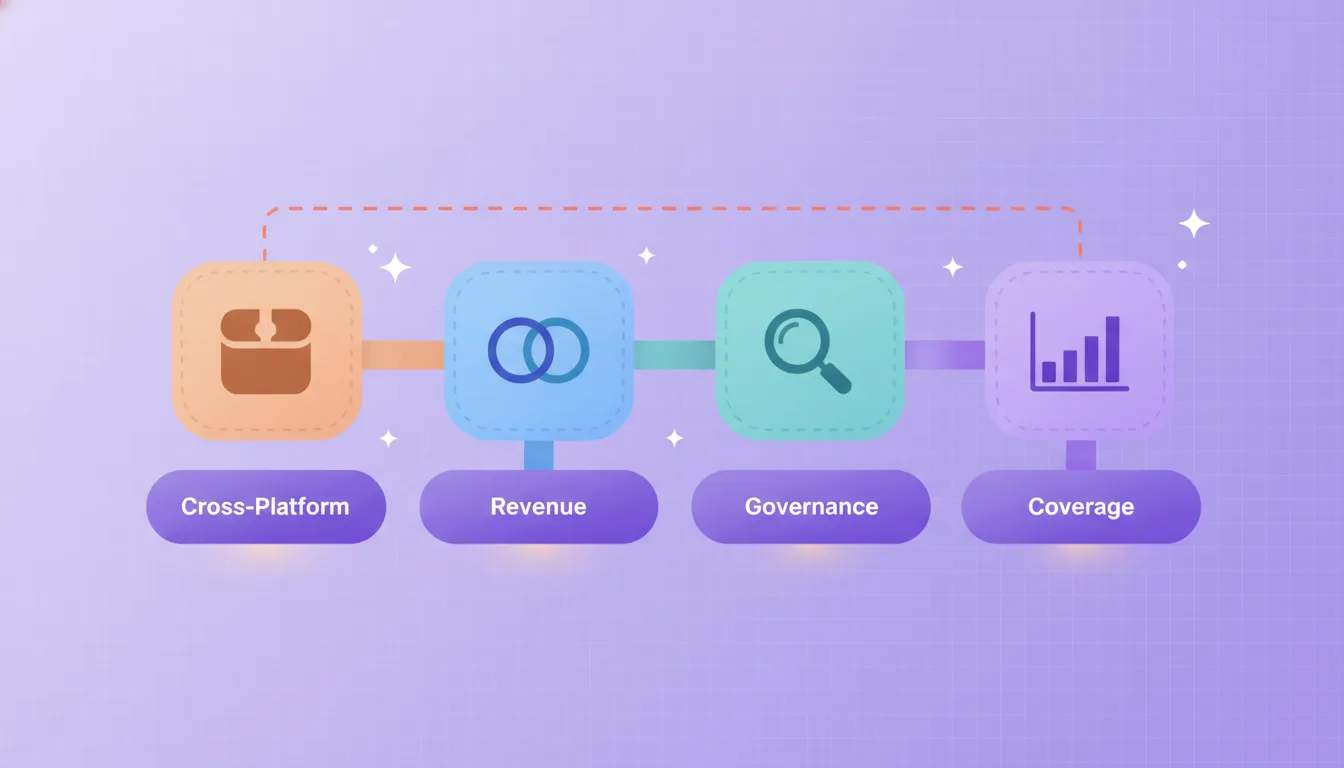
Capability gaps between platforms are fixable — Google could ship write tools next quarter. These four are structural. They exist because of what an official server is, and no amount of roadmap closes them.
Gap one: no platform can answer a cross-platform question
Google's server can tell you everything about Google Ads. It cannot tell you anything about Meta, because it has never heard of Meta. Neither can Meta's tell you about Amazon.
So the question that actually matters to a performance marketer — "which channel had the worst marginal return last month?" — cannot be asked of any official server. Not because the tool is missing, but because the data is on the other side of a company boundary. You are back to running four queries and reconciling them yourself, which is the manual work you adopted MCP to stop doing.
Gap two: none of them can see revenue
This is the expensive one, and it deserves its own section below.
Gap three: no unified governance or audit trail
Once an AI can change campaigns — and on Amazon and Meta it now can — you need answers to four questions: who approved this, what was the blast radius, can it be rolled back, and where is the log. Meta's paused-by-default rule is one partial answer. Amazon's server does not impose the same constraint.
With separate official servers, every platform answers those questions differently or not at all, and there is no single place to see what an AI did across your account estate last week. For an in-house team running one platform that is tolerable. For an agency touching a dozen client accounts it is not.
Gap four: coverage stops at advertising
Ad platform servers cover ad platforms. They do not cover Shopify, Stripe, Klaviyo, Search Console or GA4 — and the neglected ad platforms are patchy too. If Reddit or LinkedIn is a meaningful line in your budget, check whether a first-party server exists at all before you plan around one.
Gap Two: None of Them Can See Revenue
Every ad platform grades its own homework. Each one reports the conversions it believes it caused, using its own attribution window and its own view-through rules. None of them can see your bank.

Here is a worked example — illustrative numbers, not measured data, to show the shape of the problem.
A customer sees a Meta ad on Monday, searches your brand on Google and clicks an ad on Wednesday, then buys on Thursday. Meta claims the conversion under its view-through window. Google claims it under last-click. Amazon may claim a version of it too if the purchase happened there. Three platforms report one sale. Sum the platform-reported revenue and you have inflated your return by a factor no dashboard will warn you about.
Now subtract the things platforms never see: refunds, chargebacks, cancelled orders, discount codes applied at checkout, and the difference between order value and contribution margin. Platform-reported ROAS is a gross, self-claimed, pre-refund number. Your actual return is a net, deduplicated, post-refund number. They are not the same metric wearing different clothes — they measure different things.
An AI connected only to ad platform servers will confidently report the first number and has no way of knowing the second exists. It is not hallucinating. It is answering accurately from the only data it was given.
Read this next → True ROAS: Why Platform-Reported ROAS Lies
How to calculate what your campaigns actually earned once duplicate attribution, refunds and margin are accounted for — and the three connections you need before any AI can compute it for you.
When Should You Just Use the Official Server?
There is a real case for it, and pretending otherwise would be dishonest. Use the platform's own server when all of these are true:

You genuinely run one platform. If 90% of spend is on Amazon, the official Amazon server is excellent and free. Adopt it.
You want reporting, not action. Google's three read tools cover an enormous amount of analytical ground via GAQL. For a solo analyst asking questions, that is often enough.
You have engineering to spare. Self-hosting an open-source server means you own credentials, deployment and API quotas — fine if you have the team, a hidden cost if you don't.
Nobody needs an audit trail. One person, one account, no compliance requirement.
The moment a second platform enters, the arithmetic inverts. Four platforms means four OAuth flows, four setup procedures, four transports, four things breaking independently, and still no way to ask a question that spans them.
Honest limitation: An aggregating server is a dependency. You are trusting one vendor's uptime and one vendor's normalisation logic across every platform, instead of trusting each platform with its own. That is a real trade, and if you run a single platform it is a bad one. Ask any aggregator — including us — how they handle rate limits and whether they fail loudly or return partial data. A server that quietly returns half a search term report is worse than one that errors, because the model will summarise what it received without flagging the gap.
How Do You Decide?
Four questions, in order of how much regret each one prevents.
How many platforms carry meaningful spend? One, use the official server. Three or more, the reconciliation cost alone justifies aggregation.
Do you need to act, or only to know? If you need write access on Google or Microsoft today, the official servers cannot give it to you at any price.
Does the answer depend on revenue? Anything involving true return, contribution margin or refunds requires a store or payment connection no ad platform server has.
Who else touches these accounts? More than one person, or more than one client, and you need a single audit trail rather than four disconnected ones.
For a scored comparison of the aggregating servers, see the best marketing MCP servers and the Amazon-specific cut at best Amazon Ads MCP.
What Should You Take from This?
Official ad-platform MCP servers are not a uniform category. Amazon and Meta write; Google and Microsoft read. Verify per platform rather than assuming.
The four gaps that no official server closes are structural, not roadmap items: cross-platform questions, revenue visibility, unified governance, and coverage beyond advertising.
Single-platform advertisers who want reporting should use the free official server. That is the honest recommendation.
Multi-platform advertisers hit the reconciliation problem immediately, and it gets worse with every platform added.

Want One Connection Instead of Four?
Brandlio connects Google Ads, Meta, Amazon, Microsoft, TikTok, LinkedIn, Reddit, Pinterest and ChatGPT Ads with write access, plus Shopify, Stripe, Klaviyo, GA4 and Search Console for the revenue picture the ad platforms cannot see. One OAuth flow per account, one audit trail. See pricing or connect your first account.
Frequently Asked Questions
Are official ad platform MCP servers read-only?
No, not uniformly. As of August 2026 the official Amazon Ads server supports both reading and writing with 50+ tools, and Meta's supports writing with 29 tools where created entities land paused by default. The official Google Ads and Microsoft Advertising servers are read-only. Any article claiming all official servers are read-only is out of date.
Is the official Google Ads MCP server free?
Yes. It is open source and maintained by the Google Ads API team, released 28 April 2026. It exposes three tools: list accessible customers, run a GAQL search, and fetch resource metadata. It is genuinely useful for reporting and analysis, but it cannot modify bids, pause campaigns or create assets.
Why would I pay for a third-party MCP if the official ones are free?
Because official servers cannot answer questions that span platforms, cannot see your store or payment revenue, and give you no unified audit trail across accounts. If you advertise on one platform and want reporting, the free official server is the better choice. The case for paying begins at the second platform.
Can I use official and third-party MCP servers together?
Yes. MCP clients support multiple servers simultaneously, so you can run Google's official server alongside an aggregator. The trade-off is duplicated tools in the model's context, which can make it less certain which tool to call. Most teams settle on one primary server plus specialists where a platform's own server does something unique.
Does Meta's MCP server really create everything paused?
Yes. Entities created through Meta's official server land paused by default, and a human has to activate them. It is a hard-coded guardrail rather than a setting, and it is a sensible pattern — it means a mistaken tool call costs you nothing until a person reviews it. Not every write-capable server imposes the same constraint.
Which ad platforms still have no official MCP server?
Coverage is uneven. Amazon, Google, Meta, Microsoft, TikTok and Pinterest shipped first-party servers during 2026. Several platforms that carry real budget for some advertisers — including Reddit, LinkedIn and Snapchat — have patchier or no first-party support, so check before planning around one.
Can an official ads MCP server calculate my true ROAS?
No. Ad platform servers report the conversions and revenue that platform claims, using its own attribution window. They cannot see refunds, chargebacks, discount codes, contribution margin, or conversions another platform also claimed. Calculating true return requires a store or payment connection that no ad platform server has.
Do official MCP servers work in ChatGPT as well as Claude?
It depends on the transport. Hosted remote servers such as Meta's work in browser-based clients including ChatGPT and Claude on the web. Self-hosted open-source servers using local stdio transport generally require a desktop client. Check the transport a server offers before assuming your AI client can use it.